Short Answer for Travelers
Less than an hour west of Chișinău, deep inside the rolling forests of central Moldova, Căpriana feels like stepping unexpectedly into the country’s medieval past. Hidden beneath towering oak trees in the heart of the Codru forest, this centuries-old Orthodox monastery remains one of the rare places where Moldova’s early history still feels physically present rather than simply remembered.
Its origins stretch back to the early 15th century when Moldavian ruler Alexander the Good formally recognized the monastery, while later generations of princes — most notably Stephen the Great and Petru Rareș — transformed the settlement into one of the spiritual foundations of medieval Moldova. The complex preserves the oldest surviving church in the country, alongside two later churches that quietly document centuries of religious architecture in stone.
Unlike many of Moldova’s dramatic cliff monasteries, the experience here feels calmer and more contemplative. Ancient churches sit beneath dense woodland, the air carries the smell of pine and damp earth, and the unusual silence of the surrounding forest creates an atmosphere that lingers long after the drive back to the capital.
A Monastery Hidden Inside Moldova’s Oldest Forest
Driving west out of Chișinău, the landscape gradually begins to change. Apartment blocks disappear, traffic thins out, vineyards begin replacing urban sprawl, and eventually the road enters the dense woodlands of Codru — Moldova’s historic central forest region that for centuries acted as both refuge and strategic defense for medieval Moldavian rulers.
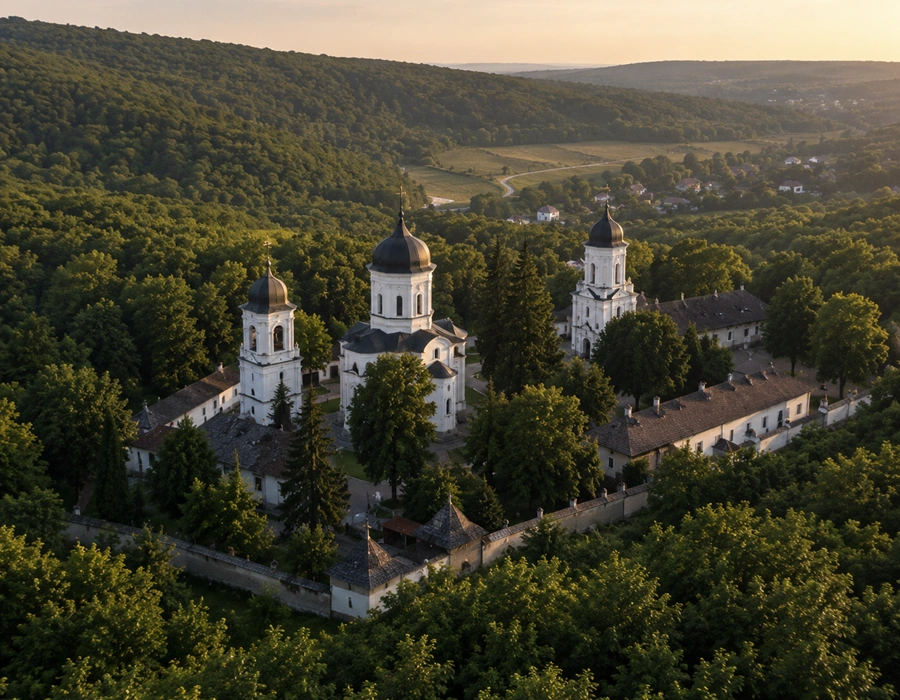
Tucked inside a shallow valley surrounded by these forests sits one of the country’s oldest surviving religious settlements. The first impression is often unexpected. Unlike monasteries built dramatically on cliffs or exposed hillsides, the entire complex feels sheltered — protected by centuries-old oak trees that seem to isolate the monastery from the outside world.
White church facades emerge quietly through the greenery, stone pathways connect buildings constructed centuries apart, and almost immediately the age of the place becomes impossible to ignore. Few places in Moldova preserve such an uninterrupted connection between the country’s medieval origins and its modern Orthodox identity.
This monastic settlement is widely recognized as the oldest continuously important Orthodox site in Moldova, with origins dating back to 1429 and architectural landmarks spanning more than five centuries of Moldovan history.
Why Moldovans Hold This Place in Special Regard
Among locals, this monastery carries significance far beyond religion alone. For many Moldovans, it represents something deeply tied to national identity — a surviving link to the era when medieval Moldova first began emerging as an independent principality under rulers whose names still dominate the country’s historical memory today.
Stories surrounding the monastery remain deeply rooted in local folklore. One of the most repeated legends tells of Stephen the Great hunting deep inside the Codru forest when news reached him that his daughter Ana had been born. Rather than killing a young roe deer standing nearby, he spared the animal and later interpreted the moment as divine intervention. According to local tradition, this event eventually helped inspire later expansion of the monastery itself.
The atmosphere here feels noticeably different from places like Țîpova or Saharna. Those monasteries often feel dramatic and visually overwhelming. Here, the experience feels quieter and older — less about scenery, more about standing somewhere that has quietly survived nearly six hundred years of political collapse, invasions, empire changes and Soviet destruction.
Reasons This Monastery Feels Historically Unique
Some destinations impress immediately through dramatic landscapes. This place works differently. The impact comes gradually. Walking through the grounds, every structure quietly reveals a different period of Moldova’s past — medieval princes, Orthodox metropolitans, Russian imperial influence, Soviet occupation and modern restoration all layered together within a remarkably compact space.
There is also something unusually intimate about the setting itself. The surrounding Codru forest softens the experience completely. Instead of exposed cliffs, steep hiking trails or crowded tourist routes, visitors move through shaded pathways beneath old trees while bells echo softly between stone church walls that have stood here since the late 1400s.
It feels less like visiting a tourist attraction and more like briefly stepping into a forgotten chapter of Moldova that somehow escaped the modern world entirely.
After visiting here, continue exploring Moldova’s spiritual heritage with our guides to Saharna Monastery, Țîpova Monastery, Curchi Monastery, or continue toward Chișinău and Orheiul Vechi.
| Comparison | Căpriana | Curchi |
|---|---|---|
| Historical age | Founded 1429 | Founded 1773 |
| Architectural style | Medieval Moldavian Orthodox | Baroque influenced |
| Main atmosphere | Quiet forest sanctuary | Grand cathedral complex |
| Photography appeal | Historic details and woodland | Large dramatic architecture |
| Accessibility | Very easy | Easy |
| Best suited for | History and culture lovers | Architecture enthusiasts |
- Moldova’s oldest monastery — Officially documented in 1429 under Alexander the Good
- Oldest surviving church in the country — Dormition Church dates back to the late 15th century
- Connected to medieval rulers — Closely tied to Stephen the Great and Petru Rareș
- Three churches in one complex — Buildings span roughly 500 years of architectural history
- Codru forest surroundings — Deep woodland setting unlike other Moldovan monasteries
- Easy day trip from Chișinău — Reachable comfortably within one hour by car

How Moldova’s Oldest Monastery Began
The earliest documented reference dates to 1429, when Moldavian ruler Alexander the Good formally granted royal privileges to what was then known as the Monastery of Vâșnovăț. At that point, the religious settlement was already active, suggesting monastic life had begun here even earlier.
The monastery would later become closely associated with Moldova’s most famous ruler, Stephen the Great, whose reign fundamentally shaped the country’s religious identity. Under his patronage, major construction projects began transforming the monastery into one of the most important spiritual centers within medieval Moldova.
During the 16th century, Prince Petru Rareș initiated further rebuilding after earlier structures had deteriorated. Over the following centuries earthquakes, invasions and changing empires repeatedly damaged the monastery, yet the settlement somehow endured through each successive period of instability.
The Soviet period nearly erased this history entirely. In 1962, communist authorities closed the monastery and repurposed the buildings for secular functions including medical facilities, agricultural storage and local administrative operations. Religious life only returned in 1989, when restoration efforts finally began reversing decades of damage.

Walking Through Six Centuries of Architecture
One of the unusual aspects of visiting here is how visibly Moldovan history reveals itself through architecture alone. Moving through the monastery grounds feels almost chronological, with each church representing a completely different historical period.
At the heart of the complex stands the Church of the Dormition, constructed during the reign of Stephen the Great between 1491 and 1496. Its proportions remain relatively simple compared with later Orthodox churches, but this restraint reflects authentic Moldavian medieval architecture before later Russian and Byzantine influences began reshaping church design across the region.
Nearby stands the Church of Saint George, followed by the later Church of Saint Nicholas completed during the early twentieth century. Together, the three churches create a surprisingly complete visual timeline showing how Orthodox architecture evolved across nearly five hundred years.
Few monastery complexes in Moldova allow visitors to observe such a clear architectural progression, with buildings from medieval Moldavia, the 19th century and early 20th century preserved within a single religious site.
- Church of the Dormition — Built under Stephen the Great between 1491 and 1496
- Church of Saint George — 19th century winter church used during colder months
- Church of Saint Nicholas — Early 20th century neo-Byzantine architecture
- Historic manuscripts — The monastery once housed rare religious texts written in Slavonic
- Stone courtyards and monastery cells — Traditional monastic structures remain active today
Its Continuing Religious Importance Today
For centuries, this monastery stood at the center of Orthodox life across historic Moldova. It served as residence for Moldovan Metropolitans, effectively functioning as one of the country’s most important ecclesiastical centers long before modern Moldova even existed in its current form.
One of the most significant religious sites within the complex is the tomb of Metropolitan Gavril Bănulescu-Bodoni, a pivotal figure responsible for shaping Orthodox religious administration across Bessarabia during the early nineteenth century. Pilgrims still arrive specifically to pay respects at his burial place inside the Dormition Church.
Unlike monasteries preserved mainly as historical attractions, religious life here remains active every day. Monks continue maintaining regular services, Orthodox celebrations still draw worshippers from across the country, and evening liturgies create an atmosphere that feels remarkably unchanged from centuries earlier.
Beyond its historical significance, this remains one of the few monasteries in Moldova where visitors experience both living Orthodox tradition and some of the country’s oldest surviving religious architecture in the same place.
Planning Your Visit
Leaving Chișinău in the late morning usually allows enough time to explore the monastery grounds slowly, spend time inside all three churches, walk through the surrounding forest paths and still return comfortably the same afternoon. Unlike more remote monasteries in northern Moldova, this visit requires very little logistical planning.
| Visitor Information | Details |
|---|---|
| Distance from Chișinău | 35 km |
| Drive time | 40–50 minutes |
| Entrance fee | Free (donation appreciated) |
| Recommended stay | 2–3 hours |
| Best season | April – October |
| Difficulty level | Very easy |
Late spring tends to feel particularly beautiful here. The dense forest surrounding the monastery becomes intensely green, birdsong fills the valley, and the contrast between white monastery walls and deep woodland creates one of the quieter landscapes anywhere near the capital.
- Allow at least 2–3 hours — Enough time to explore churches and monastery grounds slowly
- Dress respectfully — This remains an active Orthodox religious community
- Bring cash — Small donations and candle purchases are common
- Visit on weekdays — Weekends attract significantly more local pilgrims
- Combine with other destinations — Easy to pair with other central Moldova attractions
Before You Go
- Limited food options nearby
- Carry water during summer
- Religious services may temporarily restrict church access
- Limited English spoken on-site
- Cash is useful for donations and candles
How Much Time You Actually Need
Because the entire monastery complex is relatively compact, the visit rarely feels rushed. Walking through all three churches, spending time in the courtyards and moving slowly through the surrounding forest paths can comfortably fill two hours without effort.
Those interested in attending liturgy, photography or simply sitting quietly inside the grounds often stay longer. Unlike monasteries built around physically demanding hiking routes, the experience here unfolds at a much slower pace and rewards visitors willing to move gradually rather than quickly.
Two hours usually feels comfortable for exploring the full complex, while attending a service or spending time in the surrounding forest can easily extend the visit well beyond half a day.
Driving from Chișinău
The route west from Chișinău is straightforward and considerably easier than reaching many of Moldova’s more remote monastery destinations. After leaving the capital, the road gradually transitions into open countryside before entering the dense woodland landscapes of Codru, where the final approach becomes noticeably more scenic.
- Private car — The easiest and most convenient option, under one hour from Chișinău
- Taxi or ride-sharing — Easily arranged directly from the capital
- Local bus — Regular transport runs toward Strășeni and Căpriana village
- Good road conditions — One of the easier monastery drives in Moldova
Nearby Attractions
Central Moldova offers several destinations that combine particularly well with a visit here, especially for travelers building a full day around religious history, nature and local culture.
- Curchi Monastery — Spectacular Baroque architecture roughly 45 minutes away
- Orheiul Vechi — Moldova’s most famous archaeological and cave monastery complex
- Codru Forest Region — Scenic woodland landscapes ideal for short walks and photography
- Strășeni — Small regional town with cafés, local shops and transport connections
- Chișinău — Easily reached before or after a same-day monastery visit
Why This Experience Feels Different From Moldova’s Other Monasteries
Many monastery visits in Moldova revolve around dramatic scenery — limestone cliffs above the Dniester, steep hiking trails, waterfalls or isolated cave churches carved into exposed rock faces. The experience here feels entirely different.
What makes this place memorable is not dramatic geography but the unusual concentration of history contained inside such a quiet setting. Standing inside the courtyard, surrounded by churches constructed across half a millennium, visitors encounter something surprisingly rare: a place where Moldova’s medieval identity has remained physically visible despite centuries of political upheaval and repeated destruction.
The surrounding Codru forest changes the atmosphere completely. Wind moving through old oak trees, distant church bells, and the complete absence of modern noise create a kind of silence that feels increasingly difficult to find elsewhere near Chișinău.
Should You Add It to Your Moldova Itinerary?
This remains one of Moldova’s most historically significant monastery experiences, preserving six centuries of religious continuity, the country’s oldest surviving church and one of the strongest surviving links to medieval Moldovan history.
What tends to stay with people after leaving is rarely a single church or historical fact. Instead, it is the unusual atmosphere created by the entire setting itself — ancient stone walls beneath towering forest canopy, the silence surrounding the monastery courtyard, and the strange awareness that some parts of Moldova’s earliest history are still standing exactly where they began centuries ago.
Unlike more visually dramatic monastery destinations, the experience here feels quieter, older and somehow more intimate. For anyone wanting to understand Moldova beyond vineyards, Soviet architecture and modern Chișinău, few places reveal the country’s deeper historical identity more convincingly than this hidden sanctuary inside the Codru forest.
